
Python Coding Enrichment Class in Singapore
Looking for Python coding tutoring classes in Singapore? I provide personalised Python programming lessons for students who want to learn how to code, strengthen their programming fundamentals, or use Python for data analysis, statistics, research and more advanced applications.
Python is one of the most useful programming languages for students because it can be used across many different areas, from basic programming and problem solving to data science, machine learning, finance and academic research. However, learning Python effectively requires more than memorising commands. Students need to understand programming logic, know how to break a problem into smaller steps, and be able to apply Python independently.
My Python coding classes are designed to develop this understanding progressively. Depending on your current level and objectives, lessons can begin with basic Python programming and move towards functions, data structures, file handling, libraries, APIs, data analysis, data visualisation and machine learning.
I provide Python lessons tutoring in Singapore as well as online Python tutoring. Lessons can be adapted for secondary school students, JC students, diploma students, undergraduates, postgraduate students and learners who need Python for quantitative or research work.
As of 2025, I have accumulated 13 years of teaching experience on delivering mathematics and statistics subjects for secondary and tertiary level. In addition, I have 3 years of python teaching experience in python teaching for diploma, undergraduate and postgraduate coding level in Singapore and 2 years of experience in using python to conduct my own research. To date, I have two papers that has been published involved the use of python to run the data analysis.
In addition, I have received teaching related training under tertiary setting and also training on supervising postgraduate research. Consequently, I am well versed of different teaching methodologies and how to guide a student to along towards a better academic achievement. This has made me to be more confident for being a competent tutor to teach you Python programming tuition in Singapore.
In addition, I also provide mathematics and statistics tuition in Singapore. If you are looking for secondary math tutor (O-level Math tutor), Singapore A-level math tutor (JC H1 Math tutor or JC H2 Math tutor) or statistics tutor, you may contact me to find out further information.
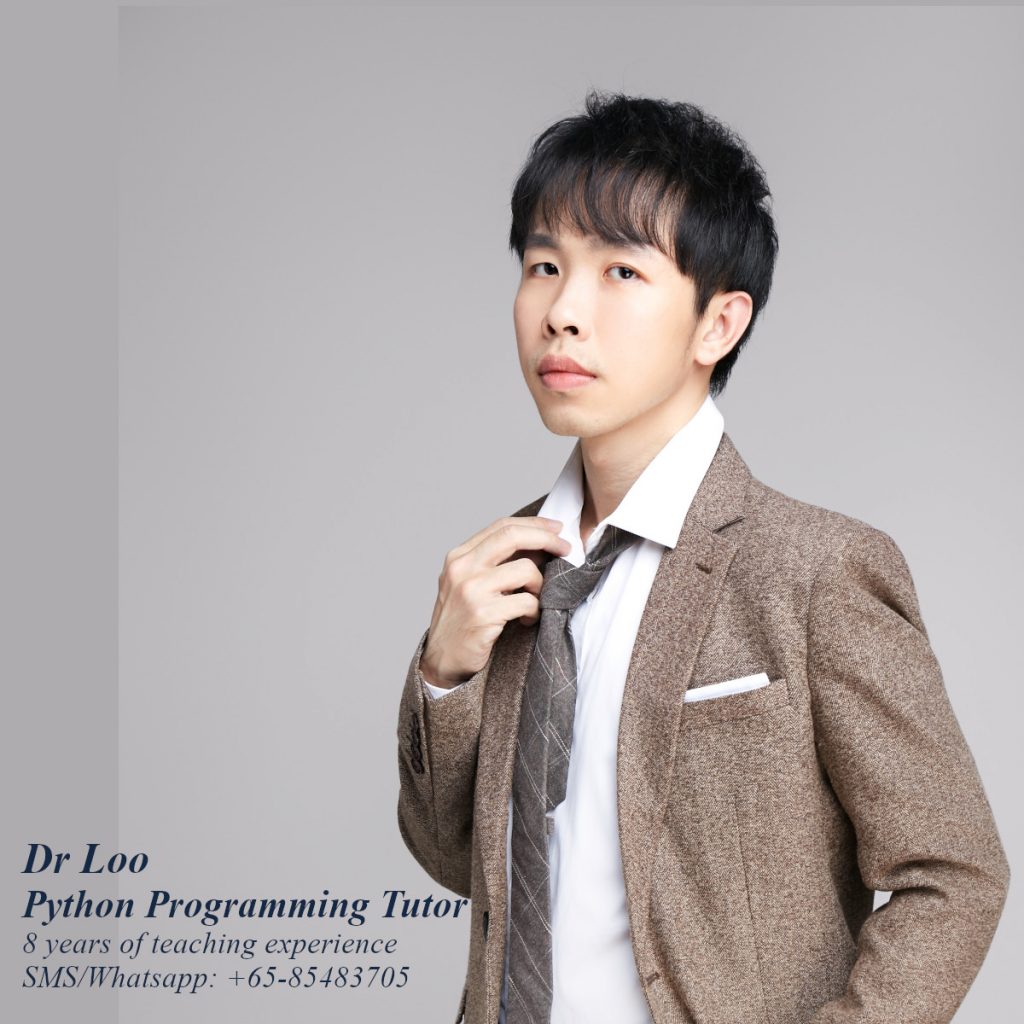
Python Programming Tutor’s Profile

Academic Qualifications
1. Doctoral Degree
PhD in Management (Major in finance), UTM
Achievement
- Best Postgraduate Student Award recipient
- Published 3 research articles on international peer reviewed journal
2. Master degree
Master in Applied Statistics, UM
Achievement
- Distinction

Teaching Experience
- 13 years of teaching experience on delivering mathematics and statistics.
- 3 years of teaching experience on python related modules such as python programming, data visualization, data analysis and natural language processing for diploma, undergraduate and postgraduate level
- Taught level: secondary school, undergraduate degree, honor degree, master student until PhD candidates.

Educational Training Attended
- Received teaching related training under tertiary setting
- Also received training on supervising postgraduate research
Python Coding Tutoring Classes in Singapore
Students learn Python for many different reasons. Some students are completely new to programming and want to learn Python from the beginning. Others may already have some programming experience but find certain concepts difficult to understand. University and diploma students may need Python for a specific academic module, while research students may need to use Python for data processing, statistical analysis or visualisation.
For this reason, I do not believe that every student should follow exactly the same lesson plan.
A beginner may need to spend more time understanding variables, conditions and loops before moving forward. A student who already understands the fundamentals may instead need help with functions, object-oriented programming, data structures or Python libraries. A university student may need a more specialised approach based on the syllabus of their Python or data-analysis module.
My aim is to help students understand why their Python code works, rather than simply giving them code to copy.
My academic and teaching background also allows me to connect Python with mathematics, statistics and quantitative analysis where appropriate. I hold a PhD in Management with a major in Finance and a Master’s degree in Applied Statistics with Distinction. I was also awarded Best Postgraduate Student.
I have teaching experience in Mathematics and Statistics as well as Python-related modules, including Python programming, data visualisation, data analysis and natural language processing. I have also used Python in my own research and published research involving Python-based data analysis.
This combination is particularly useful for students who want to learn Python not only as a programming language, but also as a practical tool for working with data.
If you are looking for a programming expert to guide you on python coding, I should be right person. Other than Python coding coaching service as well as SPSS tutoring service in Singapore. On the other hand, I also provide mathematics tuition in Singapore (O-level math tuition and JC H2 math tuition) and statistics tuition in Singapore.
My Singapore Python Coding Tuition Classes Type
Python Classes for Beginners
You do not need to be an experienced programmer to start learning Python. Beginners can start with the basic building blocks of programming and gradually develop the ability to write their own programs.
Lessons can introduce variables, data types, operators, conditions, loops and functions before progressing to more advanced concepts. The objective is to develop a solid foundation rather than rushing through a large number of topics.
Python Coding Classes for Secondary School Students
Secondary school students who are interested in programming can learn Python as a structured introduction to text-based programming. Python provides an opportunity to move beyond visual programming and begin working with real programming syntax.
Students can learn how to write programs, solve logical problems and develop their computational thinking skills. Lessons can be adjusted according to the student’s existing programming experience.
Python Classes for JC Students
Junior college students may encounter programming through computing, mathematics, data-related subjects or personal projects. Python can also provide a useful foundation for students considering computer science, data science, statistics, engineering, finance or other quantitative disciplines.
Lessons can focus on programming fundamentals, problem solving, algorithms or practical applications depending on the student’s objectives.
Python Classes for Diploma Students
Diploma students may need Python as part of a computing, business, engineering, data or other technical programme. If you are having difficulty following your Python module, personalised lessons can provide additional explanation and practice outside your regular classes.
Lessons can be aligned with the student’s existing syllabus where appropriate, while focusing on understanding the underlying programming concepts.
Python Classes for University Students
University students may use Python in subjects such as computer science, statistics, finance, economics, business analytics, engineering and data science.
I have experience teaching Python-related modules at diploma, undergraduate and postgraduate levels. Lessons can therefore be adapted to the level of the student and the type of Python programming or data-analysis work required.
Python for Postgraduate Students and Research
Postgraduate students and researchers may require Python for working with research datasets, quantitative analysis, data visualisation or other research applications.
In these situations, the objective may not simply be to become a professional programmer. Instead, the student may need to learn enough Python to work effectively with their own data and research problems.
Lessons can therefore focus on the Python concepts and tools that are most relevant to the student’s research requirements.
What You Can Learn in Python Coding Classes
The exact syllabus can be adjusted according to your level and learning objectives. A typical Python learning progression can include the following areas.
1. Python Programming Fundamentals
Students begin by learning how Python programs are written and executed. Fundamental concepts include variables, data types, numerical values, strings, operators and basic input and output.
- Python syntax
- Variables and data types
- Numbers and strings
- Arithmetic and comparison operators
- Input and output
- Basic error identification
- Writing simple Python programs
These concepts provide the foundation for everything that follows. Rather than memorising isolated commands, students should understand how individual instructions combine to form a working program.
2. Conditions and Programming Logic
After learning the fundamentals, students can begin writing programs that make decisions.
- if statements
- elif and else
- Boolean values
- Comparison operators
- Logical operators
- Nested conditions
- Problem solving using conditional logic
Understanding conditions is an important step because students begin to think about how a program should respond when different situations occur.
3. Loops and Repetition
Loops allow programs to perform repetitive tasks efficiently. Students can learn both for loops and while loops and understand when each approach is appropriate.
- for loops
- while loops
- Range
- Nested loops
- Loop conditions
- Breaking and continuing loops
- Solving repetitive programming problems
Students can practise using loops to process numbers, strings, lists and other collections of information.
4. Functions
As programs become larger, writing everything in one section of code becomes difficult to manage. Functions allow students to divide a problem into smaller, reusable components.
- Defining functions
- Parameters and arguments
- Return values
- Local variables
- Reusable functions
- Breaking complex problems into smaller tasks
Understanding functions is an important milestone because students begin to write programs in a more organised and structured manner.
5. Lists, Dictionaries and Data Structures
Python provides several built-in data structures for storing and organising information. Students can learn how to work with collections of data and choose an appropriate structure for a particular problem.
- Lists
- Tuples
- Sets
- Dictionaries
- String manipulation
- Indexing and slicing
- Iterating through collections
- Searching and processing data
These skills become particularly important when students begin working with larger datasets or more complicated programs.
6. Files, Modules, Libraries and APIs
Practical Python programming often involves information that is stored outside the program itself. Students can learn how to read and write files and how Python libraries extend the capabilities of the language.
- Reading and writing files
- Working with structured data
- Importing modules
- Using Python libraries
- Understanding APIs
- Processing information from external sources
This stage helps students move from simple classroom exercises towards more practical programming applications.
Python for Data Analysis
One of the major advantages of Python is its ability to work with data. For students studying statistics, finance, business, economics, engineering or research-related subjects, Python can become a powerful tool for analysing datasets.
Python data-analysis lessons can cover the process of importing, cleaning, transforming and analysing data. Students can learn how programming can be used to automate repetitive calculations and handle datasets more efficiently.
Depending on the student’s requirements, topics can include working with tables of data, selecting and transforming variables, calculating statistics and exploring relationships between variables.
Students who already understand statistical concepts can also learn how to implement those concepts using Python.
This is particularly useful when a student understands the statistical theory but has difficulty translating the analysis into Python code.
Python Data Visualisation
Data analysis is not complete simply because calculations have been performed. Students also need to understand how to present and interpret the results.
Python can be used to create a wide range of charts and visualisations. Students can learn how to convert datasets into meaningful graphs and how to interpret patterns shown in the visualisations.
Depending on the student’s level, lessons may include:
- Creating basic charts
- Working with numerical data
- Comparing groups
- Visualising distributions
- Plotting relationships between variables
- Customising charts
- Interpreting visual results
For students studying statistics, data visualisation can be taught together with the statistical concepts behind the charts.
Python for Machine Learning
Students who have developed a sufficiently strong Python foundation can progress towards machine learning.
Machine learning requires more than knowing how to call a Python library. Students need to understand how data is prepared, how models are trained and tested, and how results should be evaluated.
Depending on the student’s background, lessons can introduce concepts such as:
- Preparing datasets
- Training and testing data
- Features and target variables
- Regression
- Classification
- Model evaluation
- Overfitting and underfitting
- Basic machine learning workflows
A foundation in mathematics and statistics is useful when progressing into machine learning. My background in Applied Statistics allows me to explain the quantitative concepts behind the analysis alongside the Python implementation.
Python Programming for Practical Projects
Learning Python becomes more meaningful when students use programming to solve practical problems.
Depending on the student’s level, lessons can include projects that require the student to combine several Python concepts. For example, a project might require variables, conditions, loops, functions and data structures to work together.
Students who are interested in data can also develop projects involving data processing, analysis and visualisation.
The purpose of practical projects is not simply to produce something that looks impressive. More importantly, projects provide an opportunity for students to practise breaking down a problem, planning a solution, writing code, identifying errors and improving the program.
Modes of my Python Programming Tuition
- Python Programming Home Tuition in Singapore
- Online Python Programming Tutoring
- Blended Learning approach
1. Python Programming Home Tuition in Singapore
In my Python Programming home tuition classes, my objective is to address the difficulties commonly encountered by students. Therefore, each lesson is being organized such that it will be well-structured and delivered systematically to meet the learning needs of the students.
Benefit of taking Python programming private tuition
- Convenience for students
- Detailed feedback
- Personalised attention from tutor
- Learning at own pace
- Minimal distractions
Topic Coverage
- Foundation of Python
- Function and Control Flow
- Working with Files, Libraries, API
- Python Basic Operators
- Machine Learning with Python
- Python Data Visualization
- Python Data Analysis
Class size
- One-to-one Python programming private tutoring.
Class Duration
- 2 hours per class.
- One class per week.
Tuition Fees
1-1 Home Tutoring for Python
- $129-139/hour
Group python programming tutoring
- Please contact me to enquire about the python programming tuition fees for group
Location
At student’s place.
2. Online Python Programming Tuition
With the advancement of technology, Python programminng online tuition is now possible. Students can get the help out of the tutor with their quantitative data analysis skills progression in front of the computer. As statistics tutor, I have also been trained before in providing online tuition. To date, I have 3 years online mathematics & statistics teaching experience in providing online statistics tuition.
Benefit of taking online Python programming tuition
- Comfortable learning environment where students just need a computer with webcam and microphone in order to attend the class.
- Lower cost, my online Python programming tuition class’s fee would be cheaper than the face to face class.
Class size
- One-to-one Python programming private tutoring.
- Small group (3 – 6 students per session)
Online Statistics Class Duration
- 2 hours per class.
- One class per week.
Tuition Fees
One-to-one python programming tutoring
- $99-129/hour
Group python programming tutoring
- Please contact me to enquire about the python programming tuition fees for group
Venue
Online platform eg. Microsoft Team, Zoom
Start Learning Python Coding in Singapore
Whether you are starting Python from the beginning, strengthening your programming fundamentals, studying Python as part of a diploma or university course, or learning Python for data analysis and research, I can help you develop your skills through a structured and personalised approach.
Rather than giving every student the same programme, I can first understand your current Python level, academic background and learning objectives and then determine an appropriate starting point.
If you are looking for Python coding classes in Singapore, contact me to discuss your requirements.
Contact Me About Python Coding Classes
You can also contact me by WhatsApp at +65-85483705.

Frequently Asked Questions About Python Coding Classes
Do I need previous programming experience to learn Python?
No. Beginners can start with Python fundamentals. The lessons can be adjusted according to your existing knowledge.
Do you teach Python to secondary school students?
Yes. Python coding lessons can be adapted for secondary school students who want to develop their programming skills and learn text-based programming.
Do you teach JC students?
Yes. JC students can learn Python for programming, computer science, data-related subjects or preparation for further study in quantitative or technical fields.
Do you teach diploma and university students?
Yes. I have experience teaching Python-related modules to diploma, undergraduate and postgraduate students.
Can you teach Python for data analysis?
Yes. Python can be used for data processing, statistical analysis and data visualisation. Lessons can be adapted according to the student’s academic or research requirements.
Can you teach Python for machine learning?
Yes. Machine learning can be introduced once the student has an appropriate Python foundation. Mathematics and statistics may also be incorporated where relevant.
Are the classes one-to-one?
One-to-one Python coding lessons are available for both home and online learning. Small-group online arrangements may also be discussed depending on the requirements.
How long is each lesson?
My standard Python tutoring arrangement is two hours per lesson, normally once a week.
Do you provide online Python coding classes?
Yes. Online lessons can be conducted using Microsoft Teams or Zoom.
Can you follow my university or diploma syllabus?
Yes. Where appropriate, lessons can be tailored around the student’s existing module, syllabus and learning objectives.
Can Python be combined with statistics?
Yes. This is particularly relevant for students who use Python for quantitative analysis, research, finance, business analytics or statistics. My background in Applied Statistics allows Python programming and statistical concepts to be connected where appropriate.
How much do Python coding classes cost?
Current one-to-one home Python tutoring is $129–139 per hour. Online one-to-one Python tutoring is $99–129 per hour. Other arrangements can be discussed depending on the student’s requirements.
PROS AND CONS OF PRIVATE TUITION
Pros
Sometimes it could be difficult to choose whether to take a private math tuition class or join a group tuition. I would like to offer some of my advice regarding the selection. The tutor only has one student to teach in a private math tuition class. Thus, the tutor would be able to give the full focus to the student. In addition, the structure of a class and how a lesson is being delivery will be customized according to the pace of the student.
Cons
However, the cost of private math tuition is normally more expensive than group tuition class.

List of my Singapore Mathematics Tuition Services
Statistics Home Tuition
- Statistics Tuition (Singapore)
- Business Statistics Tuition (Singapore)
- Psychology Statistics Tuition (Singapore)
- Quantitative Data Analysis Tuition (Singapore)
- Econometrics Tutoring in Singapore
- SPSS Data Analysis Tutoring (Singapore)
- Eviews Data Analysis Tutoring (Singapore)
List of my Singapore Mathematics Online Tutoring Services
Statistics Online Tuition
- Statistics Online Tuition (Singapore)
- Business Statistics Online Tuition (Singapore)
- Psychology Statistics Online Tuition (Singapore)
- Quantitative Data Analysis Online Tuition (Singapore)
- Econometrics Online Tuition
- SPSS Data Analysis Online Tutoring (Singapore)
- Eviews Data Analysis Online Tutoring (Singapore)